When companies develop enterprise software, the focus is almost exclusively on the backend: database scalability, APM monitoring, and processing power. Design is often treated as an afterthought—a quick coat of "Bootstrap" paint over a complex data grid.
But what happens when your employees or customers actually have to use that software?
The Hidden Financial Drain
Bad UI/UX is not just "ugly." It is an active drain on your company's resources. When an interface is confusing or cluttered, it leads to:
1. Training Overhead
If a new hire needs a 3-week onboarding course just to figure out how to submit an invoice on your internal portal, the software has failed. Good UI is intuitive; it teaches the user how to navigate it simply by existing.
2. High Error Rates
Poor visual hierarchy and massive, unorganized forms lead to data entry errors. In e-commerce, this means lost sales. In healthcare, it means compromised patient data. In fintech, it means devastating financial mistakes. Every error requires support tickets, manual intervention, and wasted salary hours to fix.
3. Employee Churn
Your team wants to do good work. Forcing them to wrestle with a slow, unresponsive, and visually hostile internal tool for 8 hours a day destroys morale. Frustrated employees leave.
The ROI of Design Excellence
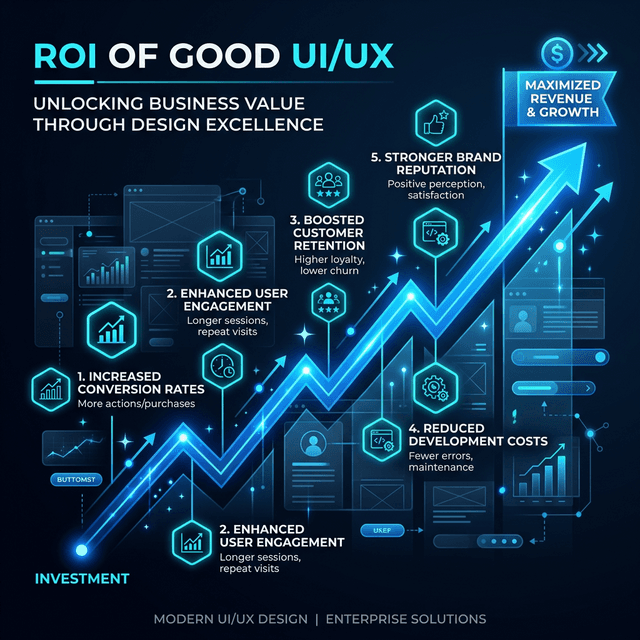
Investing in premium UI/UX is not an expense—it is an investment with a massive multiplier effect.
* Decreased Support Costs: When users can figure out the interface intuitively, they don't submit support tickets. Your L1 helpdesk costs drop overnight.
* Increased Conversion: For public-facing SaaS, a frictionless, beautiful onboarding flow directly correlates to higher trial-to-paid conversion rates.
* Faster Task Completion: If a clean UI saves an employee 5 minutes a day, and you have 1,000 employees, you just saved 20,000 hours a year.
Summary
Stop treating UI/UX as "making things pretty." Treat it as what it is: the single most effective way to optimize human-computer interaction, reduce operational waste, and drive measurable revenue growth.