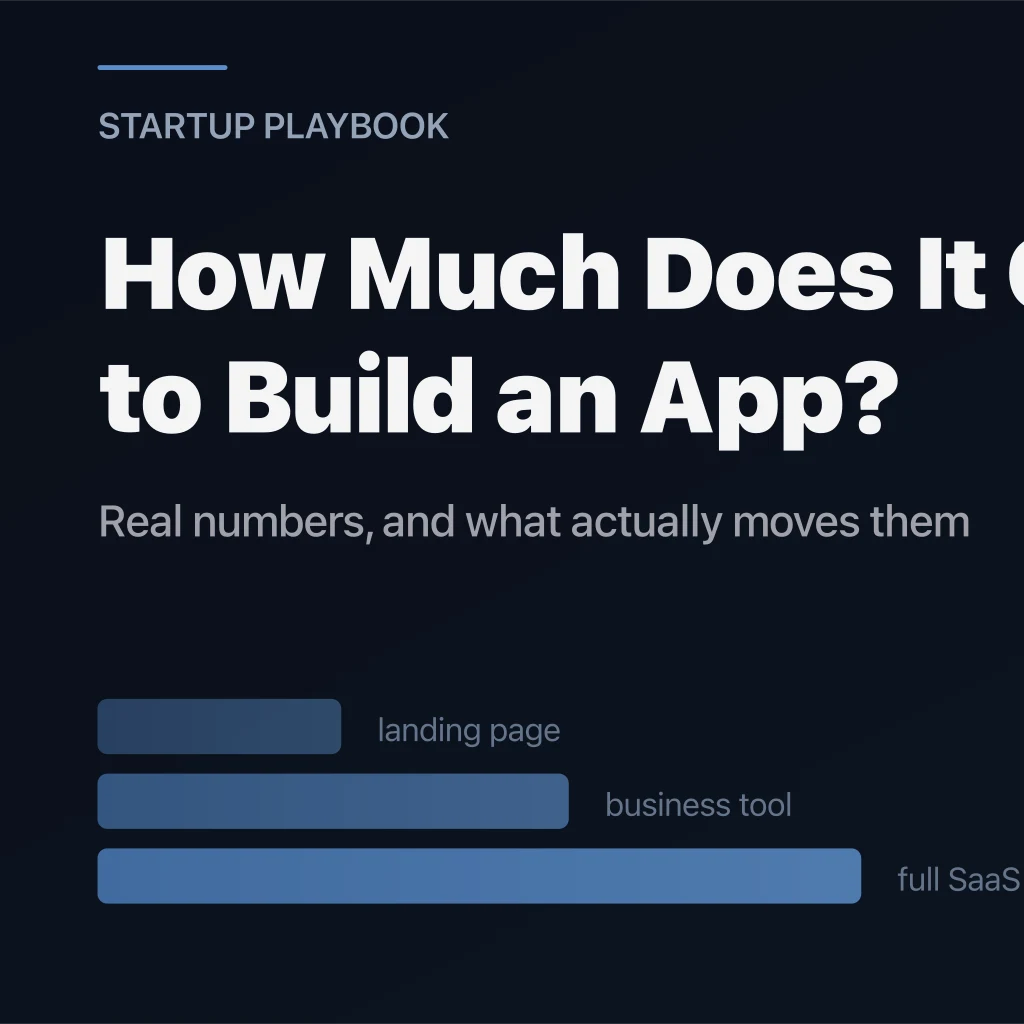
If you ask five people what it costs to build your app, you'll get five answers between $3,000 and $150,000. That's not because someone is lying. It's because "an app" isn't one thing, and almost nobody explains what moves the number.
Here's the honest version, from someone who quotes this work for a living.
The short answer
For a first version that real customers can actually use and pay for, most projects land in one of these bands:
| What you're building | Realistic range |
|---|---|
| Landing page or simple booking site | $2,000 – $6,000 |
| Business tool with accounts and a dashboard | $8,000 – $18,000 |
| Full SaaS product (auth, billing, admin) | $15,000 – $40,000 |
| Marketplace or two-sided platform | $30,000 – $80,000+ |
Anything below those ranges is usually a template with your logo on it. Anything far above usually includes an agency's overhead rather than more product.
The five things that actually move the price
1. Accounts and permissions. "Users can log in" is cheap. "Admins see everything, managers see their own team, and customers see only themselves" is not. Every distinct role multiplies what has to be built and tested.
2. Payments. Taking a one-off card payment is a day's work. Subscriptions, refunds, proration, failed-payment retries, and invoices are weeks. Be specific about which one you need.
3. Anything real-time. Chat, live tracking, notifications, collaborative editing — these change the architecture, not just the feature list. Real-time is the single most underestimated line item I see.
4. Integrations with systems you don't control. Connecting to a POS, an accounting package, or a supplier's API is unpredictable by nature. Their documentation is wrong more often than you'd think, and you can't fix their outages.
5. Native mobile vs. mobile web. A fast mobile website covers most business cases. App Store distribution, push notifications, and camera or offline access are what justify a native app — and roughly double the surface area.
What doesn't cost as much as people expect
Design, usually. A clean, credible interface built on a solid design system is a fraction of the cost of the logic behind it. Founders often over-invest in visual polish before they know whether anyone wants the product.
Hosting, too. Most early products run for $20–$100 a month. The infrastructure bill is rarely the problem — the human time is.
Where quotes go wrong
The suspiciously low quote. If a full product comes in at $2,000, you're being sold a template, an offshore team juggling twelve projects, or a demo that collapses the first busy day. I get called in to fix these regularly, and the repair often costs more than doing it properly the first time.
The vague high quote. A five-figure number with no breakdown of features, timeline, or what happens when you want a change is a red flag. A serious quote tells you what's included and what isn't.
Hourly with no ceiling. Hourly is fine for ongoing work. For a first build it transfers all the risk to you. Ask for a fixed scope with a fixed number, and a clear process for changes.
How to spend less without getting burned
Cut features, not quality. Halving your feature list halves the cost honestly. Halving the rate usually just moves the cost to later, when you're paying someone to untangle it.
Be specific about the one thing your product must do well. Most first versions are 60% features nobody uses. Deciding what to leave out is the highest-leverage cost decision you'll make — and it's free.
Get the plan written down before you get quotes. A clear scope makes quotes comparable, and it stops the price drifting once work starts.
A realistic timeline to go with the number
Cost and time move together. A focused first version is typically 5–8 weeks with one experienced builder. If you want the timeline side of this in detail, I broke it down in how long it takes to build a SaaS product.
And if you're weighing whether to build at all, build vs. buy is worth reading first — sometimes the right answer is an off-the-shelf tool and no build at all.
Get a number for your specific idea
Generic ranges only go so far. Describe what you're building in the free MVP planner and you'll get a plan with the features to build first, a suggested stack, and a realistic cost band for your idea — in about a minute, with no signup.
If the number looks workable, tell me what you're building and we'll firm it up.